Spring Symposium – Untethered: Politics and Speech on the Internet
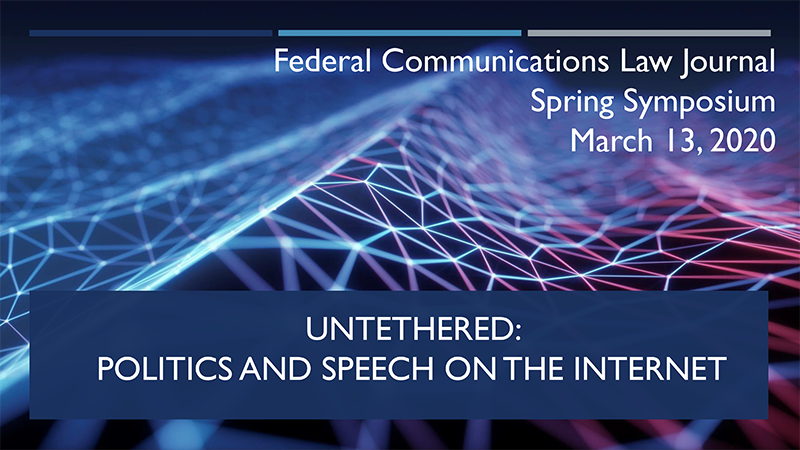
We are pleased to announce the Volume 72 Symposium will be held March 13, 2020 with the working title of Untethered: Politics and Speech on the Internet. Please save the date for the Symposium:
When:
Friday, March 13, 1:00-4:00 PM
Where:
GW Law Jacob Burns Moot Court Room
2000 H Street NW, Washington, DC 20052
Contact:
Robert Mang, Executive Editor
fcljsymposium@law.gwu.edu
The Symposium will explore lessons from the 2012 and 2016 elections, and insights and best practice addressing misinformation, consumer privacy, and advertisement transparency. It is especially timely to further this discussion today, as social media platforms grapple with increased public scrutiny as it relates to the practices moderating political advertising in advance of the 2020 elections. CLE credit available.
Manuscripts
The FCLJ invites the submission of unsolicited articles, comments, essays, and reviews. Manuscripts cannot be returned unless a self-addressed, postage-paid envelope is submitted with the manuscript.
Copyright
Copyright © 2019 Federal Communications Bar Association. Except as otherwise provided, the author of each article in this issue has granted permission for copies of that article to be made for classroom use, provided that (1) copies are distributed at or below cost, (2) the author and the FCLJ are identified, (3) proper notice of copyright is attached to each copy, and (4) the FCLJ is notified of the use.
Production
Joe Christensen, Inc., in Lincoln, Nebraska
Citation
Please cite issues as [VOL#] Fed. Comm. L.J. [PAGE #] (year), e.g. 69 Fed. Comm. L.J. 1 (2016). The citations of the Journal conform to the Bluebook: A Uniform System of Citation (20th ed. 2015), copyright by the Columbia, Harvard, and University of Pennsylvania Law Reviews and The Yale Law Journal. Variations exist for purposes of clarity and at the editors’ discretion.
The views expressed in articles printed herein are not to be regarded as those of the Federal Communication Law Journal, the editors, The George Washington University, the Federal Communications Bar Association, or the Editorial Advisory Board.